Harness, Crate or Guard: Sorting Fact From Marketing on UK Dog Car Travel in 2026
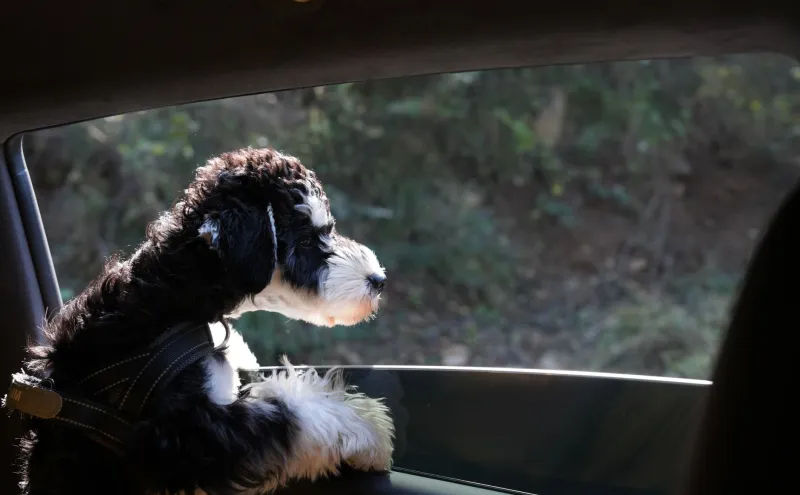
Half the battle of bringing your dog along is getting there. And of all the ways to travel with an animal in the UK, the car is the one where owners most often assume they already know the rules — usually because someone told them once, in a pub, with great confidence.
So let's separate the three things that get muddled together: what the law requires, what your insurer expects, and what actually protects a dog in a 30mph stop. They overlap, but they're not the same, and treating them as one is how people end up buying a £19.99 harness and calling it safety kit.
What the Highway Code actually says
Rule 57 is the one everybody half-remembers. It asks drivers to make sure dogs and other animals are 'suitably restrained' so they can't distract you, or injure you or themselves, if you stop quickly. It then names the usual suspects: a seat belt harness, pet carrier, dog cage or dog guard.
Note the wording. The Highway Code isn't a statute in itself — it's a code of practice, and it uses 'should' rather than 'must'. That's why you'll see people confidently claim there's no law about dogs in cars at all.
That claim is technically true and practically useless.
The law that sits underneath the guidance
Two strands matter. First, the Road Traffic Act 1988: driving without due care and attention, or dangerous driving, both bite if an unrestrained animal causes you to lose control. A dog on your lap or clambering between seats is exactly the sort of distraction courts have taken a dim view of.
Second, the Road Vehicles (Construction and Use) Regulations 1986 require loads to be secured so they can't move and cause danger or injury. A 30kg Labrador travelling loose is a load. An unsecured crate is also a load — a rigid, heavy one that becomes a projectile in a sudden stop.
So the honest summary is this: there's no single 'dogs must be in a crate' law, but a combination of careless driving and load-securing rules means an unrestrained dog can land you in real trouble, particularly after a collision.
The insurance paragraph nobody reads
Most UK motor policies don't have a dedicated 'dog clause', which is why owners assume they're covered. But insurers assess claims on whether you took reasonable care, and an unrestrained animal in the cabin is precisely the sort of detail that can be used to argue contributory negligence.
In practice that could mean your own damage claim is reduced, or in the worst cases declined, even though third-party liability (the bit that pays for the other person's car) normally still stands. Pet insurance is a separate matter again — it generally covers illness and injury, not the cost of a written-off boot.
Worth a two-minute check of your policy wording, or a quick call to your insurer before you spend money on kit. Some will note a dog on the policy; most just expect you to have restrained it properly.
How to read a 'crash-tested' claim
Here's the uncomfortable truth about the UK pet travel market: there is no mandatory British or EU standard specifically for dog harnesses or car crates. A manufacturer can call a product crash-tested without telling you what was tested, at what speed, or with what weight of dog.
That doesn't mean good products don't exist. It means you have to interrogate the label. Useful things to look for:
- A named test facility — MIRA, TÜV, or an equivalent independent lab, rather than 'our own rigorous testing'.
- The test speed — most meaningful harness tests run at around 30mph (48km/h). A test at 15mph tells you very little.
- The dog weight tested — a harness proven with a 10kg terrier isn't automatically proven with a 35kg retriever. Match the product to your dog, not to the photo.
- The attachment method — a harness should never clip to a collar. Look for a proper seat belt loop or a short tether that limits movement without allowing the dog to reach the front seats.
For crates, check whether it's secured to the car (ISOFIX points, or strapped through the boot's lashing eyes) and whether the manufacturer references luggage-retention testing. A crate that isn't fixed in place is not a safety device, whatever it cost.
Harness, crate or guard — which suits your dog?
There's no universal answer, and anyone selling you one is overselling.
A harness suits dogs that travel on the back seat and settle well. It's compact, easy to move between cars, and works for shorter trips. It's weakest for very large dogs and for dogs that spin, chew or panic.
A crate is generally the better bet for bigger dogs and for anyone doing longer motorway runs, provided it's properly anchored and big enough for the dog to stand, turn and lie down. Too-small crates are common and cause more distress than they prevent.
A dog guard keeps a dog in the boot but doesn't stop it being thrown forward into the seat back. Fit one that bolts to the car's mounting points rather than a tension-fit version that can shift under load.
And a note on the front seat: airbags deploy at speed and are designed around adult humans. Most manufacturers and safety bodies advise against it, so rear seat or boot is the sensible default.
Taxis, private hire and rideshares
This is the greyest area of all, and it trips people up on nights out.
Assistance dogs are the clear case. Under the Equality Act 2010, taxi and private hire drivers in the UK must carry assistance dogs and cannot charge extra for them, with fines of up to £1,000 for refusal unless the driver holds a valid medical exemption certificate.
For ordinary pets, there's no equivalent right. A hackney carriage or private hire driver can refuse, and licensing conditions vary by council. Rideshare apps have started offering pet-specific options in some UK cities, but availability is patchy and you're relying on the individual driver opting in.
Practical move: book ahead, say clearly what size dog you have, and expect to pay for the privilege. Turning up at the kerb with a wet Labrador and hoping is how arguments start.
A five-minute pre-journey check
Before you turn the key, run through this:
- Is the dog restrained by something fixed to the car, not just to itself?
- Can it reach the pedals, the gear stick or your face? If yes, it isn't restrained.
- Is the crate anchored, or loose in the boot?
- Have you got water, shade and a plan for the other end of the trip?
- Is it warm? Then don't leave the dog in the car at all — the Animal Welfare Act 2006 gives owners a duty of care, and a distressed dog in a hot car is a 999 call, not a debate.
None of this requires an expensive shopping spree. It requires matching the kit to the dog, reading past the marketing, and accepting that 'suitably restrained' means something more specific than a lead looped round the headrest.