Trains, Trams and Terriers: Getting Your Pet Around the UK in 2026
Here's a sentence that sums up UK public transport with pets: it is broadly permitted, inconsistently documented, and quietly left to the discretion of whoever is standing at the barrier that morning.
On most National Rail services, a dog travels free. On a coach, it may be refused outright. On a ferry, it might cost a fiver or nothing at all depending on the route. None of that is hidden information, exactly — it just lives in the small print of a dozen different operators, none of whom use quite the same wording.
The short version, before the detail
- Most UK train operators allow up to two dogs per passenger, free of charge, on a lead, off the seats.
- Assistance dogs are always welcome, everywhere, by law.
- Buses and trams are usually at the driver's discretion; small pets in carriers are almost always fine.
- Coaches are the strictest — many carry only assistance dogs.
- Ferries tend to be the most relaxed, provided you follow the deck rules.
- Rules change. Check the operator's own page the week you travel, not the forum post from three years ago.
Trains: the national picture
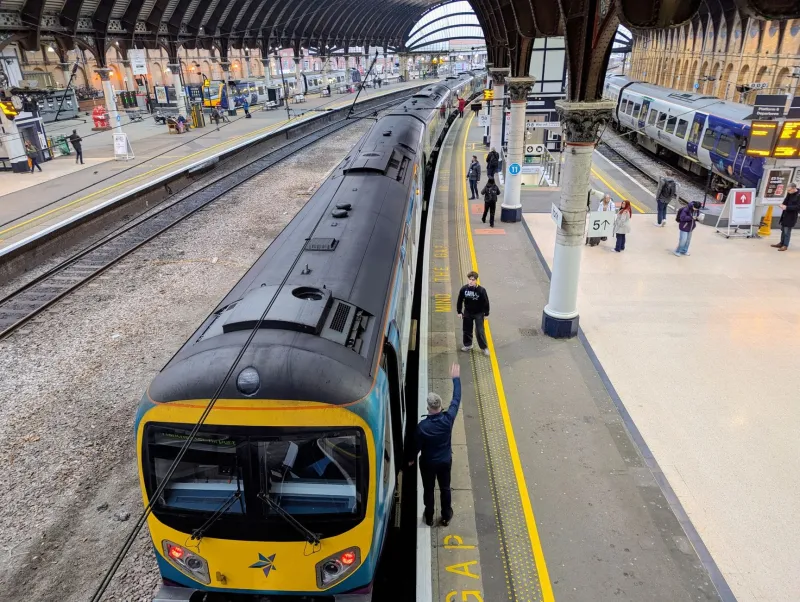
The default across most of the National Rail network is generous. Dogs travel without a ticket, typically limited to two per traveller, must be kept on a lead, and are not allowed to occupy a seat. Some operators also ask that dogs stay out of buffet cars and, on busy services, in the vestibule area.
Long-distance operators such as LNER and Avanti West Coast follow that pattern: two pets free, seats are for humans, and staff may ask you to move if the carriage is full. ScotRail is similarly welcoming and, on certain busier routes, asks that dogs travel in the vestibule rather than the saloon. Commuter operators running into major cities often don't publish anything beyond the basics, which in practice means it's fine and you shouldn't be surprised if a guard asks you to keep the dog close during rush hour.
Reservations aren't usually required for the dog itself, but booking a seat — especially a table or the space near the doors — is worth doing on anything longer than an hour. It's the difference between a calm journey and a 90-minute negotiation with the person in 43B.
London: buses, Tube and Overground
Transport for London's rules are consistent across the network: dogs travel free, but you're expected to carry them on escalators (a genuine safety rule, not a quirk), keep them off seats, and not let them block doors or gangways. On buses, one dog per passenger is allowed at the driver's discretion — which is the phrase that does a lot of heavy lifting across the whole country. In practice, a well-behaved dog on a short lead gets on without comment.
Worth knowing: a dog that barks continuously, or one travelling at 8am on a packed Northern line service, will test even the most accommodating driver. Peak hours are not the moment to be experimental.
Trams and light rail
Tram networks tend to be quietly permissive. Manchester's Metrolink, Edinburgh Trams, Sheffield's Supertram and Nottingham's Express Transit all generally allow dogs free, on a lead, off the seats, with staff discretion applying on busy services. Edinburgh is the tidiest example of a written policy most people never read.
What trams don't have is space. A busy tram at 5pm is not a place to bring a bouncy spaniel, however welcome it technically is.
Coaches: the awkward middle child
This is where the UK's pet-friendly reputation falls apart. National Express and most long-distance coach operators generally carry only assistance dogs. Some smaller and regional operators accept small pets in carriers, and a handful of services on tourist routes are more flexible, but you cannot assume it. If a coach is part of your plan, phone the operator rather than relying on a website that hasn't been updated since the pandemic.
Ferries: usually the easiest leg
Ferry operators are, by and large, the grown-ups here. CalMac carries dogs on most routes, free, with kennels available on some longer crossings and dogs expected to stay on a lead in passenger areas. Cross-Solent operators such as Wightlink and Red Funnel accept dogs on foot passenger services, sometimes with a small charge, sometimes not — check per route. Cross-Channel operators generally require dogs to stay in the vehicle or in designated kennels, and foot-passenger travel with a pet is limited.
Eurostar sits in its own category: pets travel in a carrier, there's a per-journey fee, and assistance dogs travel free. Book it as part of the ticket rather than turning up at St Pancras hoping for the best.
The unwritten etiquette that makes it work
No operator publishes these. Every regular pet traveller follows them.
- Walk the dog before boarding. A tired dog is a quiet dog. A station forecourt is not a toilet, so plan a proper stop beforehand.
- Short lead, always. A retractable lead in a carriage is a trip hazard and a complaint waiting to happen.
- Ask before sitting down. Not legally required. It defuses 90% of awkwardness.
- Bring a mat or blanket. It gives the dog a floor spot and signals to other passengers that you've thought about it.
- Avoid the peak. If you can travel at 10:30 rather than 08:15, do.
- Don't let the dog greet strangers. Some people are frightened, some are allergic, some just want to read their book.
- Clean up, and carry bags. Train toilets are not a disposal option.
Why 'pet-friendly' still means almost nothing
Here's the honest take. The UK's pet transport policy isn't hostile — it's patchy. A dog can ride free from Inverness to London and then be refused entry to a coach heading twenty miles down the road. That inconsistency isn't cruelty, it's just a lack of joined-up thinking across dozens of operators who each set their own terms.
The practical result is that responsibility lands on the owner: read the operator's page, ring ahead for anything unusual, and assume discretion means discretion. Do that, and the vast majority of UK journeys go smoothly. The dog sleeps, the guard nods, and the whole thing costs you nothing but a bit of planning.